Doubling the speed & efficiency of flexible electronics
Stretching out the atomic structure of the silicon in the critical components of a device can be a good way to increase a processor's performance
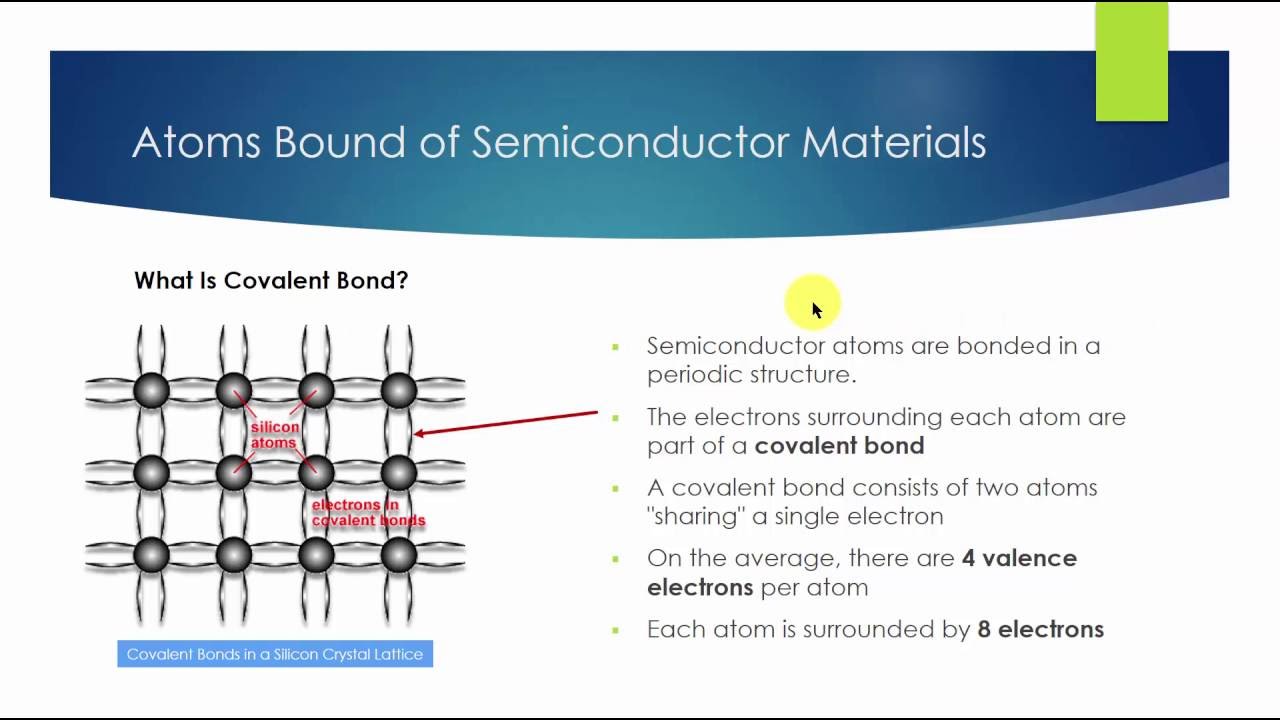
Creating "stretched" semiconductors with larger spaces between silicon atoms, commonly referred to as "strained silicon," allows electrons to move more easily through the material.
Historically, the semiconductor industry has used strained silicon to squeeze a bit more efficiency and performance out of the conventional microprocessors that power the desktop and laptop computers we use today.
However, manufacturers' inability to introduce strained silicon into flexible electronics has limited their theoretical speed and power to, at most, approximately 15 gigahertz.
Now, thanks to a new production process being pioneered by University of Wisconsin-Madison engineers, that cap could be lifted.
"This new design is still pretty conservative," says Zhenqiang (Jack) Ma, a professor of electrical and computer engineering. "If we were more aggressive, it could get up to 30 or 40 gigahertz, easily."
Ma and his collaborators reported their new process in Nature Scientific Reports on February 18th, 2013.
Ma tried to address a paradox for straining and doping silicon electronics built on a flexible substrate. The straining process is similar to stretching out a T-shirt: the researchers pull a layer of silicon over a layer of an atomically larger silicon germanium alloy, which stretches out the silicon and forces spaces between atoms to widen.
This allows electrons to flow between atoms more freely, moving through the material with ease-just as a T-shirt stretched over a dummy will have more space between threads, allowing it to breathe.
The problem comes during the doping process. This critical step in semiconductor manufacturing introduces impurities that provide electrons that ultimately flow through the circuit. Doping a stand-alone sheet of strained silicon is like ironing a decal onto a stretched T-shirt. Just as an ironed-on design cracks when the T-shirt is stretched and unstretched, the act of doping distorts the flexible free-standing silicon sheet, limiting its stability and usefulness as a material for integrated circuits.
Ma believes that using the material to design next-generation flexible circuits will yield flexible electronics that offer much higher clock speeds at a fraction of the energy cost.
"We needed to dope this material in a way that the lattice structure within would not be distorted, allowing for silicon that is both strained and doped," says Ma.
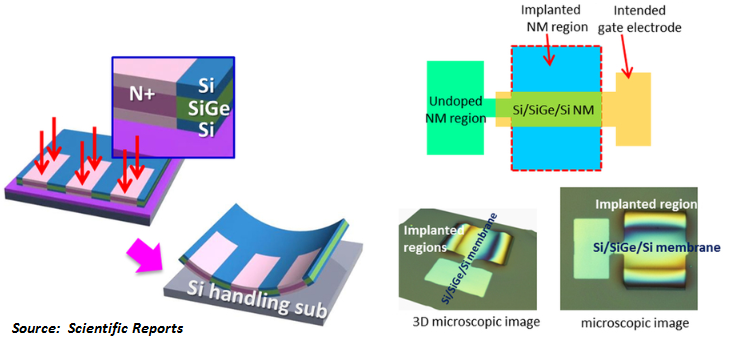
The solution is akin to dying a pattern into the fabric of a shirt, rather than ironing it on. Ma and his UW-Madison collaborators - Max Lagally, the Erwin W. Mueller Professor and Bascom Professor of Surface Science and Materials Science and Engineering; and Paul Voyles, an associate professor of materials science and engineering - have developed a process through which they dope a layer of silicon, then grow a layer of silicon germanium on top of the silicon, then grow a final layer of silicon over that. Now, the doping pattern stretches along with the silicon. The structure is shown in the schematic at the top of this story.
"The structure is maintained, and the doping is still there," says Ma.
The researchers call the new structure a "constrained sharing structure." Ma believes that using the material to design next-generation flexible circuits will yield flexible electronics that offer much higher clock speeds at a fraction of the energy cost.
The next step will be to realise processors, radio frequency amplifiers, and other components that would benefit from being built on flexible materials, but previously have required more advanced processors to be feasible. "We can continue to increase the speed and refine the use of the chips in a wide array of components," says Ma. "At this point, the only limit is the lithography equipment used to make the high-speed devices."
This work is further described in the paper, "Fast flexible electronics with strained silicon nanomembranes," by Han Zhou et al in Scientific Reports, 3, Article number: 1291. DOI :10.1038/srep01291