Beyond High-NA EUV: Particle accelerator technology promises exciting future for lithography
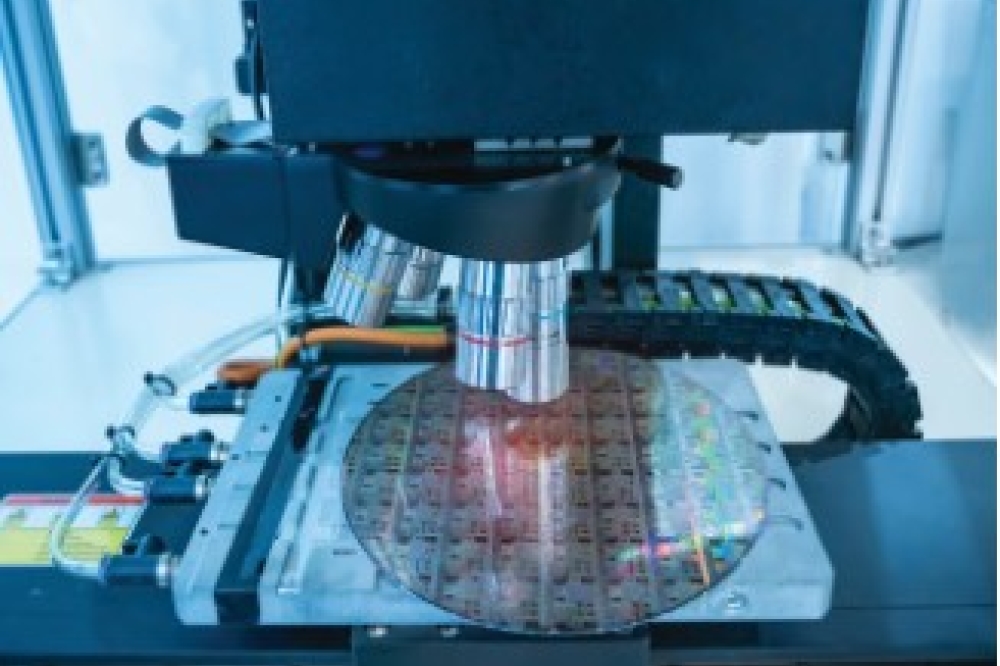
Jerome Paye, CEO of TAU Systems, outlines how the company’s
compact free-electron laser technology addresses the semiconductor industry’s
most pressing bottleneck, manufacturing ever smaller, more complex chips at a
faster rate than currently possible.
The semiconductor industry is entering a period of profound transition. As extreme ultraviolet (EUV) lithography approaches both its physical and economic limits, and as AI-driven workloads push demand for ever-denser and more energy-efficient compute, the question of “what comes next” has shifted from theoretical to urgent.
High numerical aperture (High-NA) EUV systems represent the current frontier, but even these machines are increasingly viewed as stepping stones rather than endpoints.
Jerome Paye, a senior technology leader working at the intersection of accelerator physics and semiconductor manufacturing, outlines a vision that departs significantly from conventional lithography roadmaps: compact, laser wakefield acceleration (LWFA)-driven light sources designed to replace traditional EUV source architectures. The implications of such a shift are not incremental - they suggest a potential restructuring of how advanced lithography tools are conceived, built, and integrated into fabrication environments.
The approaching limits of EUV scaling
The semiconductor industry’s lithography roadmap has historically been defined by successive leaps in light source technology - from deep ultraviolet (DUV) to EUV, and now toward High-NA EUV. Each transition has enabled smaller feature sizes, tighter transistor densities, and improved performance-per-watt.
However the industry is now approaching a critical
inflection point.
The current EUV ecosystem, particularly at the 13.5 nm wavelength, is already the product of extraordinary engineering trade-offs. It relies on a complex chain of systems: high-power CO₂ lasers, tin droplet plasma generation, and highly specialized multilayer mirrors capable of reflecting EUV photons with extreme precision. Even within this optimized architecture, further scaling is becoming increasingly difficult.
High-NA EUV extends resolution by increasing optical
numerical aperture, but at the cost of dramatically more complex and expensive
optical systems. The industry is therefore confronting a dual constraint:
physical limits in wavelength reduction and escalating economic burdens in
system scaling.
This is not a distant concern. It is a present-day engineering reality requiring immediate research investment.
Each lithography generation requires long development cycles, meaning that “what comes after High-NA EUV” must already be in development today if it is to be viable in the next decade.
From accelerator physics to lithography: a shift in paradigm
The proposed alternative originates not from traditional
semiconductor equipment design, but from the field of particle acceleration and
free-electron laser (FEL) science.

Laser Wakefield Acceleration (LWFA) uses ultra-intense laser pulses to generate plasma waves capable of accelerating electrons over extremely short distances. The compact accelerator technology is proven. Getting to high repetition rate and average power is the engineering challenge. This approach can produce electron beams of very high energy and brightness in compact footprints compared to conventional radio-frequency accelerators.
These electron beams can then be used to generate extremely
bright radiation sources, including in the X-ray regime, via undulator
structures or related emission mechanisms.
This brightness is the key differentiator. In semiconductor lithography, the ability to generate extremely fine features depends directly on photon brightness and coherence. Traditional EUV sources, while powerful, are fundamentally incoherent plasma emitters - closer in behaviour to a light bulb than a laser pointer.
By contrast, accelerator-driven systems offer the possibility of far higher brightness and potentially more coherent emission, opening pathways to tighter feature control and improved pattern fidelity.
This technological lineage is not purely theoretical. Large-scale facilities such as the Stanford Linear Accelerator Center (SLAC) and the European XFEL (European X-ray Free-Electron Laser) have already demonstrated the extraordinary brightness achievable with FEL-based architectures. However, these installations are vast - spanning campus-scale infrastructure and hundreds of meters of accelerator tunnels. The challenge, therefore, is not whether the physics works, but whether it can be miniaturized into something compatible with semiconductor manufacturing environments.
Rethinking EUV: from incoherent plasma to tunable sources
To understand the significance of LWFA-based lithography
sources, it is important to contrast them with the existing EUV generation
method.
Conventional EUV systems rely on high-power lasers firing at
streams of tin droplets. These droplets are vaporized into plasma, and as the
tin ions recombine, they emit EUV radiation centered around 13.5 nm.
This wavelength is not arbitrary; it represents a carefully
optimized balance between mirror reflectivity, resist sensitivity, and plasma
efficiency.
However, the emission process is inherently incoherent. It produces photons across a distribution of phases and directions, requiring extensive downstream optics to collect, filter, and shape the usable radiation.
Moreover, EUV lithography is locked into a tightly coupled system constraint: the light source, reflective optics, and photoresist materials must all be co-optimized around a single wavelength. This “Goldilocks zone” is one of EUV’s greatest engineering achievements - but also one of its fundamental limitations.
The LWFA-based approach aims to break this constraint by
introducing a tunable light source. Rather than forcing all subsystems to
converge around a fixed wavelength, the source itself can be adjusted. This
decouples one of the most rigid dependencies in lithography system design. Such
tunability could allow engineers to select optimal wavelengths for both mirror
coatings and resist chemistry, rather than forcing all components into a
narrow, predefined band. In principle, this could simplify the materials science
challenge that has historically constrained lithography scaling.
Economic and energy constraints in advanced lithography
Beyond physics, economics plays a central role in determining lithography viability. Today’s EUV scanners, particularly those developed by leading equipment manufacturers such as ASML, represent some of the most complex and expensive machines ever built.
Their cost structure is driven by multiple subsystems:
- High-power laser sources, often housed in separate installations
- Precision plasma generation systems
- Multilayer reflective mirror systems with near-atomic precision
- High-speed wafer handling and positioning systems
Each subsystem is independently complex, and together they create a capital-intensive ecosystem.
Energy consumption is also a growing concern. EUV systems require significant electrical input to generate usable photon output, and as throughput demands increase, energy scaling becomes a non-trivial constraint for fabs.
The LWFA-based approach proposes a rebalancing of this
equation. By focusing exclusively on the light source component, and by
leveraging highly efficient laser-to-light conversion mechanisms, the goal is
to improve the capital efficiency and energy performance of the most
fundamental element of the lithography chain.
Rather than attempting to replicate the full complexity of EUV systems, the strategy is to replace one critical bottleneck: the light source itself.
Compact systems and fab integration
One of the most striking differences between traditional
accelerator-based light sources and the proposed LWFA system is physical scale.
Conventional FEL facilities, including those at SLAC and the European XFEL,
require extensive tunnel infrastructure and dedicated buildings. This scale is
incompatible with semiconductor fabrication environments, where floor space is
both expensive and tightly constrained. The envisioned alternative is
dramatically smaller, on the order of
a shipping container.
This reduction in footprint is not merely an engineering convenience. It fundamentally changes deployment strategy. Rather than centralizing light generation in a remote facility and distributing beams (a non-starter for EUV due to loss and complexity), the system can be integrated directly into fabrication facilities.
This enables a “one light source per scanner” model, analogous to current EUV tool architectures, but with significantly reduced spatial and infrastructural demands. Fabs cannot be relocated to accommodate equipment. Instead, equipment must adapt to the existing fab environment. This design philosophy is central to the LWFA development roadmap.
Toward industrial reliability: repetition rate and stability
A major challenge in translating accelerator physics into semiconductor manufacturing lies in reliability and repeatability. Laboratory systems often operate under conditions that are unsuitable for industrial deployment.
The system under development is based on a 100 Hz laser repetition rate, supplied via a dedicated industrial laser configuration. While modest compared to eventual lithography throughput requirements, this represents a significant step forward from earlier academic demonstrations.
Repetition rate is critical because it enables feedback
control systems. At sufficiently high pulse frequencies, real-time
stabilization becomes possible, allowing correction for vibration, drift, and
other environmental factors.
However, lithography is ultimately an average power problem. To meet industrial throughput requirements, both pulse energy and repetition rate must scale together. The current work therefore focuses on a dual challenge: increasing per-pulse energy while simultaneously increasing repetition frequency, all while maintaining beam stability and reproducibility.
AI demand and the economics of scaling nodes
The urgency of next-generation lithography is being accelerated by the rapid expansion of AI workloads. AI accelerators and advanced logic devices require increasingly complex patterning, pushing lithography systems toward their limits.
One of the key constraints in current EUV-based manufacturing is multi-patterning. When a single exposure is insufficient to define a feature, multiple exposures are required, increasing cost, reducing throughput, and adding process complexity.
Shorter wavelengths, potentially achievable through LWFA-driven sources, could enable single-pattern exposures for features that currently require multiple steps. This would represent a major shift in manufacturing economics, reducing both cycle time and process variability.
This is a return to a more direct patterning regime, where scaling is achieved through physics rather than repeated process layering. While fundamental physical limits ultimately remain - no lithography system can extend indefinitely toward atomic-scale resolution - the potential headroom beyond current EUV systems is considered significant.
Roadmap: from laboratory system to industrial tool
The path from experimental accelerator technology to semiconductor-grade lithography source is long and complex. The most critical milestones are not purely about performance, but about industrialization.
Key priorities include:
- Increasing repetition rate for higher throughput
- Achieving pulse-to-pulse stability
- Demonstrating long-term operational reliability
- Integrating diagnostic and feedback systems for real-time control
The system currently being developed is intended as a testbed for these capabilities. It incorporates extensive diagnostics and stabilization mechanisms designed to convert a scientific instrument into a production-grade tool.
The interviewee acknowledged that this transition is non-trivial and likely to take years, comparable in complexity to the historical development of EUV itself. However, they also noted a key advantage: modern development benefits from decades of prior work in free-electron laser research across global institutions.
Unlike earlier generations of lithography innovation, much of the foundational physics has already been demonstrated in large-scale scientific facilities.
Redefining Moore’s law through new light sources
The broader question raised by this technology is whether it
could extend or reshape the trajectory of Moore’s law. Rather than focusing
solely on transistor scaling, the next phase of semiconductor advancement may
depend on the evolution of the lithography light source itself.
If compact, accelerator-driven systems can deliver higher
brightness, shorter wavelengths, and improved tunability, they could open a new
scaling
pathway beyond EUV and High-NA EUV.
However, this is not as a replacement for existing technology, but as an expansion of possibilities. The goal is not to declare EUV obsolete, but to remove the current bottlenecks that limit future node development.In this sense, LWFA-based lithography represents a potential third paradigm shift in optical lithography: following deep UV, EUV, and now toward tunable accelerator-driven sources.
A new frontier for lithography infrastructure
The semiconductor industry has repeatedly reinvented its
core manufacturing technologies to sustain scaling. From optical lithography to
immersion systems and EUV, each transition has required a convergence of
physics, engineering, and economic alignment.
Laser wakefield acceleration represents a radically different direction - one that draws from high-energy physics rather than traditional optical engineering. Its promise lies not only in performance but in rethinking the architecture of light generation itself.
While significant challenges remain in scaling, stability,
and integration, the potential impact is substantial: smaller footprints,
tunable wavelengths, improved energy efficiency, and new pathways for
resolution scaling.
As AI continues to accelerate demand for compute, and as EUV approaches its structural limits, the search for the next lithography paradigm is no longer speculative. It is becoming a defining question for the future of semiconductor manufacturing.
Whether compact accelerator-driven light sources ultimately
fulfill that role remains to be proven. But the direction of travel is
increasingly clear: the next revolution in lithography may not come from better
optics alone, but from fundamentally rethinking how light itself is generated.