IHS: Apple and Samsung still warring
Apple and Samsung remained the world's largest buyers of semiconductor chips in 2013, but the intensifying battle between the two for the hearts and minds of consumers in their product offerings could presage another mighty showdown this year for the top ranking, according to a new report from IHS Technology.
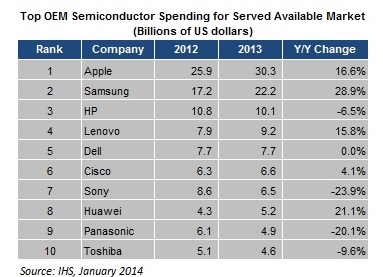
"As in 2012, Apple and Samsung were the top semiconductor spenders in 2013 among original equipment manufacturers (OEM) making more than $1 billion in revenue," says Myson Robles-Bruce, senior analyst for semiconductor spend and design analysis at IHS.
"Apple was in first place with chip spending in 2013 of $30.3 billion, outspending runner-up Samsung's $22.2 billion by more than $8 billion. However, the South Korean electronics titan attained the largest spending increase on chips of any Top 10 OEM last year, up almost 30 percent from 2012 levels, compared to a smaller expansion of 17 percent on the part of Apple."
Combined, the two claimed about 14 percent of total spending in 2013, well ahead of other prominent chip buyers. Rounding out the Top 5 are Hewlett-Packard in third place, with $10.1 billion in spending; Lenovo in fourth, with $9.2 billion; and Dell in fifth, with $7.7 billion. The rest of the Top 10 includes Cisco Systems, Sony, Huawei Technologies, Panasonic and Toshiba, as shown in the attached table.
All told, the served available market (SAM) for semiconductor spending reached $237.2 billion in 2013, up nearly 5 percent after spending dipped from $231.7 billion in 2011 to $226.7 billion in 2012.
The SAM metric counts only expenditures that an OEM made as an external agent, which gives a truer picture of the state of chip spending in the electronics industry. This is because SAM does not factor in spending by manufacturers for chip buying done at their own internal divisions as can happen with entities like Samsung, whose internal customers within the vast Samsung family of companies compete with external clients in sourcing Samsung-made semiconductors.
The findings are contained in the report, "Wireless and Industrial Boost Semiconductor Spending," which tracks the semiconductor procurement of more than 200 electronics companies.
Apple and Samsung: no end seen to fierce rivalry
In the consumer market Apple and Samsung continue to face off in their smartphones and tablet offerings, where the two are locked in fierce combat. Apple remains the leader on both fronts, with its iPhone and iPad selling in greater numbers than Samsung's Galaxy line of handsets and tablets.
Increasingly, however, Apple is finding it hard to hold ground against an onslaught of competitors - including a well-armed Samsung, Robles-Bruce noted. In smartphones, for instance, Samsung's strategy includes an effort to sell models even in areas of the world with already high smartphone penetration. The high cost of the iPhone, in contrast, has prevented the handset from being widely adopted in developing countries where markets remain ripe for penetration"”despite a recent iPhone victory in China for broad distribution and huge sales for its new Apple iPhone 5s.
Samsung's unmistakable intention to use flexible active-matrix organic light-emitting diode (AMOLED) display technology on its product offerings could also be a future differentiator from products made by Apple, which has clearly indicated it wants nothing to do with OLED technology. If OLED technology catches on with consumers, Apple could start to suffer, which would be reflected in the California maker's prodigious chip-buying powers.
Meanwhile in tablets, Samsung has likewise made great strides. Its share in the global tablet market has climbed to about 22 percent, closing in on Apple's 30 percent market share, in a space that Apple virtually owned and was once thought to be impregnable.
Such volatile dynamics between the two contenders could make for another lively tug of war when figures are calculated at the end of the year for the semiconductor spending crown, with results likely to be watched closely by all quarters.
Wireless spending is still king
Spending last year on semiconductors was strongest in the wireless segment among seven different application categories.
Wireless accounted for nearly one-third of total OEM chip spending at 31 percent, followed by chip spending on computer platforms at a distant second with 22 percent. In third place was chip spending on consumer devices, at 16 percent.
The remaining four categories claimed single-digit share in total OEM chip spending. These segments include industrial, automotive, wired communications and computer peripherals.
The top OEM buyers in the wireless segment were Apple, Samsung, Huawei, ZTE and LG. And for the first time, spending on tablets overtook that on wireless infrastructure. Both were still well behind handsets, which remained far and away the top category for OEM chip spending in the wireless segment.
Wireless was also the fastest-growing application segment this year, up 20 percent; with industrial electronics in second place, up 7 percent.