+44 (0)24 7671 8970
More publications     •     Advertise with us     •     Contact us
 
News Article

On the way to breaking the terahertz barrier for graphene nanoelectronics
News
Scientists discover that electrical conduction in graphene on the picosecond timescale is governed by the same basic laws that describe the thermal properties of gases allowing scientists and engineers to improve the performance of graphene-based nanoelectronic devices.

A team of scientists at the Max Planck Institute for Polymer Research (MPI-P) discovered that electrical conduction in graphene on the picosecond timescale -- a picosecond being one thousandth of one billionth of a second -- is governed by the same basic laws that describe the thermal properties of gases. This much simpler thermodynamic approach to the electrical conduction in graphene will allow scientists and engineers not only to better understand but also to improve the performance of graphene-based nanoelectronic devices.

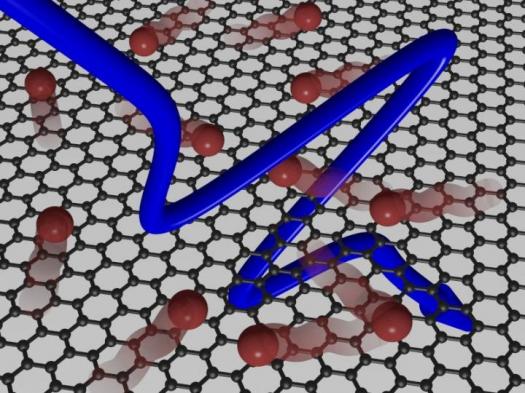
The researchers found that the energy of ultrafast electrical currents passing through graphene is very efficiently converted into electron heat, making graphene electrons behave just like a hot gas. "The heat is distributed evenly over all electrons. And the rise in electronic temperature, caused by the passing currents, in turn has a strong effect on the electrical conduction of graphene" explains Professor Mischa Bonn, Director at the MPI-P. The study, entitled "Thermodynamic picture of ultrafast charge transport in graphene," has recently been published in Nature Communications.

Graphene -- a single sheet of carbon atoms -- is known to be a very good electrical conductor. As a result, graphene finds a multitude of applications in modern nanoelectronics. They range from highly efficient detectors for optical and wireless communications to transistors operating at very high speeds. A constantly increasing demand for telecommunication bandwidth requires an ever faster operation of electronic devices, pushing their response times to be as short as a picosecond. "The results of this study will help improve the performance of graphene-based nanoelectronic devices such as ultra-high speed transistors and photodetectors" says Professor Dmitry Turchinovich, who led the research at the MPI-P. In particular they show the way for breaking the terahertz operation speed barrier -- i.e. one thousand billions of oscillations per second -- for graphene transistors.


Purdue, imec, Indiana announce partnership
Resilinc partners with SEMI on supply chain resilience
NIO and NXP collaborate on 4D imaging radar deployment
Panasonic Industry digitally transforms with Blue Yonder
Global semiconductor sales decrease 8.7%
MIT engineers “grow” atomically thin transistors on top of computer chips
Keysight joins TSMC Open Innovation Platform 3DFabric Alliance
Leti Innovation Days to explore microelectronics’ transformational role
Quantum expansion
indie launches 'breakthrough' 120 GHz radar transceiver
Wafer fab equipment - facing uncertain times?
Renesas expands focus on India
Neuralink selects Takano Wafer Particle Measurement System
Micron reveals committee members
Avoiding unscheduled downtime in with Preventive Vacuum Service
NFC chip market size to surpass US$ 7.6 billion
Fujifilm breaks ground on new €30 million European expansion
Fraunhofer IIS/EAS selects Achronix embedded FPGAs
Siemens announces certifications for TSMC’s latest processes
EU Chips Act triggers further €7.4bn investment
ASE recognised for excellence by Texas Instruments
Atomera signs license agreement with STMicroelectronics
Gartner forecasts worldwide semiconductor revenue to decline 11% in 2023
CHIPS for America outlines vision for the National Semiconductor Technology Center
TSMC showcases new technology developments
Alphawave Semi showcases 3nm connectivity solutions
Greene Tweed to open new facility in Korea
Infineon enables next-generation automotive E/E architectures
Global AFM market to reach $861.5 million
Cepton expands proprietary chipset
Semtech adds two industry veterans to board of directors
Specialty gas expansion
×
Search the news archive

To close this popup you can press escape or click the close icon.
Logo
×
Logo
×
Register - Step 1

You may choose to subscribe to the Silicon Semiconductor Magazine, the Silicon Semiconductor Newsletter, or both. You may also request additional information if required, before submitting your application.


Please subscribe me to:


You chose the industry type of "Other"

Please enter the industry that you work in: